Sunday, August 25, 2013

OD: The Changing World of HR

25 August 2013, Singapore: In 2007, a HR competency study co-sponsored by RBL Group and University of Michigan Ross School. The study identifies six (6) competencies that are essential for HR professional who adds value to a business / organization. These competencies were previously considered for OD professional: -


  • The Credible Activist: being credible (respected, listened to) and active (offering a point of view and challenging others' assumptions)
  • The Operational Executor: flawlessly executing the operational aspect of managing people and organizations
  • The Business Ally: contributing to the success of the business by understanding its social context, how it makes money, and how to organize its parts to make more money
  • The Talent Manager / Organization Designer: mastering theory, research, and practice in both talent management and organization design
  • The Strategy Architect: having a vision of how the organization can succeed in the marketplace and actively shaping the strategy to fulfill this vision
  • The Culture and Change Stewards: recognizing, articulating, and shaping corporate culture and facilitating the change processes required to keep the culture aligned with the business needs
(Source: OD Network (2013), Handbook for Strategic HR: Best Practices in OD from OD Network. AMACOM)


OD Interventions


What is OD Intervention?

  • a set of sequenced, planned actions or events intended to help an organization to increase its effectiveness. 
  • purposely disrupt the status quo; they are deliberate attempts to change an organization or sub-unit toward a different and more effective state.


Criteria for Effective Interventions

  1. The Extent to Which it (the Intervention) fits the needs of the organization
  2. The degree to which it is based on causal knowledge of intended outcomes
  3. The extent to which the OD intervention transfers change-management  competence to organization members.


Factors That Impact the Success of OD Interventions ...

Factors relating to Change Situation: 

  1. Readiness for Change 
  2. Capability to Change 
  3. Cultural Context 
  4. Capabilities of the Change Agent (OD Consultant)


Factors Related to the Target of Change
A. Organizational Issues

  1. Strategic Issues
  2. Technology and Structure Issues
  3. Human Resource Issues
  4. Human Process Issues


B. Organizational Levels
OD interventions are aimed at different levels of the organization: individual, group, organization and trans-organization (for example different offices of the organization around the globe; or between organization and its suppliers, customers, etc.)

OD interventions has four sets of attributes to the organization setting;

  1. A set of values
  2. A set of assumptions
  3. A set of goals
  4. A set of structured activities.


OD Interventions are classified on the basis of:

  1. The objectives of interventions
  2. The targets of the interventions.


Major Categories of OD Interventions

  • Diagnostic activities
  • Team-building activities
  • Inter group teams
  • Survey feedback activities
  • Education and training activities
  • Techno structural and structural activities
  • Process consultant activities
  • Grid organization development activities


Wednesday, August 21, 2013

Organizational Diagnostic Models

21 August 2013, Singapore: Enclosed is the short version of all the organizational diagnostic models ... source: HR Intelligence Report - Organizational Diagnostic Models: A Review & Synthesis (2008), Leadersphere Inc.


Force Field Analysis (1951)

Leavitt’s Model (1965)


Likert System Analysis (1967)

Open Systems Theory (1966)

Weisbord’s Six-Box Model (1976)

Congruence Model for Organization Analysis (1977)


McKinsey 7S Framework (1981-82)

Tichy’s Technical Political Cultural (TPC) Framework (1983)

High-Performance Programming (1984)

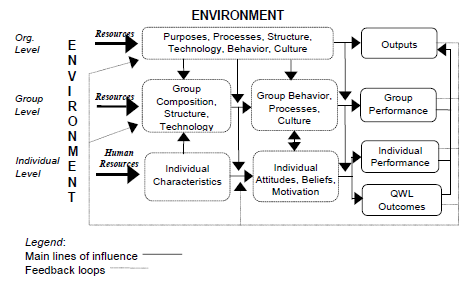
Diagnosing Individual and Group Behavior (1987)

Burke-Litwin Model of Organizational Performance & Change (1992)

Falletta’s Organizational Intelligence Model (2008) 

Tuesday, August 20, 2013

Moral Leadership

20 August 2013, Singapore: The past one week, I keep hearing 'Moral Leadership'. My colleague shared with me that as you go higher the corporate life, moral become an important factor when you made decision that affect people lives. Listed below are just some of the references I extracted ....

What is Moral Leadership?

Moral leadership is leading in a manner that includes the responsibility for ensuring standards of moral and ethical conduct.


Key Points of Moral Leaderships.
  • Leading in a manner that respects the rights and dignity of others.
  • Leaders also hold the responsibility for ensuring standards of moral and ethical conduct.
  • Leaders can influences their followers / subordinate’s attitude and values - a moral leader will stimulate a moral influence.
  • Leaders make known their values and ethics and preach them in their leadership styles and actions.


Monday, August 19, 2013

Organizational Diagnostic Model - Weisbord’s Six-Box Model (1976)

19 August 2013, Singapore: Weisbord (1974) proposes six broad categories in his model, these categories included (1) purposes, (2) structures, (3) relationships, (4) leadership, (5) rewards, and (6)helpful mechanisms.

(source: Leadersphere, Inc. (2008), Organizational Diagnostic Models) 


Weisbord refer and defined them as follow  ...
  1. Purposes of an organization are the organization’s mission and goals.
  2. Structure as the way in which the organization is organized e.g., by function; or by product, program; or project.
  3. Relationships is the ways in which people and units interact. It also included in the way in which people interact with technology in their work.
  4. Rewards are the intrinsic and extrinsic rewards people associate with their work.
  5. Leadership refers to typical leadership tasks, including the balance between the other categories.
  6. Helping mechanisms are the planning, controlling, budgeting, and information systems that serve to meet organizational goals. 

Listed below are samples of some of the questions he poses are as follows:
  • Purposes: Do organizational members agree with and support the organization’s mission and goals?
  • Structure: Is there a fit between the purpose and the internal structure
  • of the organization?
  • Relationships: What type of relations exist between individuals, between departments, and between individuals and the nature of their jobs? Is their interdependence? What is the quality of relations? What are the modes of conflict?
  • Rewards: What does the organization formally reward, and for what do organizational members feel they are rewarded and punished? What does the organization need to do to fit with the environment?
  • Leadership: Do leaders define purposes? Do they embody purposes in their programs? What is the normative style of leadership?
  • Helpful Mechanisms: Do these mechanisms help or hinder the accomplishment of organizational objectives?


Thursday, August 15, 2013

Introduction to Organization Development (OD)


15 August 2013, Singapore: On August 08, I decided to join the famous OD Network, USA - for the next 30 days I need to bush-up my OD knowledge. I was able to access their online OD articles. Noted that their OD definitions were less academic and very applicable to my current project.
 
What is Organization Development?
Moving away from the classical definition, some of the leaders in OD Network defined it as:
 
"OD is a field directed at interventions in the processes of human systems (formal and informal groups, organizations, communities, and societies) in order to increase their effectiveness and health using a variety of disciplines, principally applied behavioral sciences. OD requires practitioners to be conscious about the values guiding their practice and focuses on achieving its results through people."
Arnold Minors, Toronto, Canada
 
"Organization Development is a body of knowledge and practice that enhances organizational performance and individual development, viewing the organization as a complex system of systems that exist within a larger system, each of which has its own attributes and degrees of alignment. OD interventions in these systems are inclusive methodologies and approaches to strategic planning, organization design, leadership development, change management, performance management, coaching, diversity, and work/life balance."
Matt Minahan, Silver Spring, Maryland
 
Dr. Binghay in his lecture notes, stated the following ...
Nature of Organization Development
  • Is a planned, organization-wide effort to increase organization’s effectiveness & viability
  • A response to change
  • A complex organizational strategy to change the beliefs, attitudes, values, & structure of organization
  • A change process designed to bring about a particular kind of end result
  • Can involve interventions in the organizations processes
  • Uses behavioural science as well as organizational reflection, system improvement, planning, and self analysis
Organization Development is aimed at:
  • Enhancing congruence among organization structure, process, strategy, people, & culture
  • Developing new & creative organizational solutions
  • Developing the organization’s self-renewing capacity
Emergence of OD
  • The need for organizational reforms
  • The focus on cultural change
  • The increase in social awareness
Reason for Undergoing OD
  • The need for organizational reforms
  • The focus on cultural change
  • The increase in social awareness
OD Values
  • Respect for People
  • Trust & Support
  • Power Equalization
  • Confrontation
  • Participation
 

Organization Development (OD): Definitions and Five Stems of OD Practice

15 August 2013, Singapore: I notice organizations in Singapore and Malaysia are looking for HR managers / director with competency in Organization Development (OD). In this article, I would like to share the various definition of OD and the five (5) stems of OD practice between the 1950s until present day.

Definitions:

OD is a planned process of change in an organization’s culture through the utilization of behavioural science technology, research, and theory... [Warner Burke, 2004]


OD refers to a long-range effort to improve an organization’s problem-solving capabilities and its ability to cope with changes in its external environment with the help of external or internal behavioural-scientist consultants... [Wendell French, 1984]


OD is an effort (i) planned, (ii) organization-wide, and (iii) managed from the top, to (iv) increase organization effectiveness and health through (v) planned interventions in the organization’s “processes” using behavioural science knowledge... [Richard Beckhard , 1969] 

OD is a system-wide process of data collection, diagnosis, action planning, intervention, and evaluation aimed at: (1) enhancing congruence between organizational structure, process, strategy, people, and culture; (2) developing new and creative organizational solutions; and (3) developing the organization’s self-renewing capacity. It occurs through collaboration of organizational members working with a change agent using behavioural science theory, research, and technology... [Michael Beer, 1987]

OD is a system-wide application and transfer of behavioural science knowledge to the planned development, improvement, and reinforcement of the strategies, structures, and processes that lead to organization effectiveness... [Thomas Cummings & Christopher Worley , 2008]
 

 [Source: Cummings & Worly, 2005]


Saturday, July 20, 2013

The Concept of Gamification in the Context of HRM

20 July 2013, Singapore: For the last few months, I came across the word "Gamification" in www.cousera.com It didn't cross my mind until I came across this blog "cool insights" by Walter Lim.
 
My only tips to you on this article is "How do you distinguish between work and play?" Great concept! Click the link to read the article ... you will like the way the article compare Work vs Game

Assessment Process for Retrenchment Exercise?

20 July 2013, Singapore: One of the tasks that HR professions dislike most is executing a retrenchment exercise. Other similar terminology: Layoff; Job redundancy; Involuntary separation program (ISP); Voluntary separation program (VSP); Voluntary separation scheme (VSS); Involuntary separation scheme (ISS); RIF (reduction in full-time-headcount).
Sometimes working with a large MNC or Global organization, at site level / business unit level, you have not control on the decision made by corporate leadership. It is all about numbers. This article is not about criticizing the decision making process but to share with you what to do when it happen.
In some countries, the employment law requires the following practices e.g., last in first out, evidence of company poor performance, negotiate with unions (if it is a unionism environment), evidence alternative has been implement before conducting retrenchment, etc.)
If you are being asked to perform an ISP / ISS – it is always wise to do your homework and consult an approved legal consul by your corporate. In Singapore, the Ministry of Manpower (MOM) has a dedicated section in their website on retrenchment. You can click the link:
In addition to the employment law, internally the company needs to develop an ‘assessment’ tool to determine who get shortlisted for the retrenchment package. One organization I know, adopted the following assessment tool with 5 factors: -
  • Achieves Results 
  • Criticality of Skills
  • Qualifications
  • Business Orientation
  • Interpersonal Skills
The assessment can be a 5 scale ranking, see below: -
  • 5 = Role Model
  • 4 = Exceeded Expectation
  • 3 = Meet requirement
  • 2 = Need to improve
  • 1 = Unsatisfactory / Poor
The main advantages of having an ‘assessment’ process in place during a retrenchment is that: -
  • It makes the selection decision more objective, fair & consistent process to assess strongest & weakest contributors.
  • It helps management in making the decision in selecting candidates for retrenchment.
One of the disadvantages of this assessment process is people selected will be viewed and discriminated as non-performance.

Sunday, June 23, 2013

Annoucement: Up-date about 'Free' Online Courses Website ... improvement done!

23-Jun-2013: With the Haze going over 400 psi and Singapore authority advising the populations to stay in-door, I kept myself busy by browsing the Internet ... looking for online course to keep myself occupy.
 
I have notice that there are a lot of additional courses and improvement on the following online website: -
 
  • edX courses (website: https://www.edx.org/ ) : One year plus ago, when I visited edX website, their courses were limited to 'engineering' or 'future techno' but today there is more non-engineering free courses like e.g., Age of Globalization ... a 15 weeks course program. The best part now is they are issuing edX certificate of mastery.


  • Coursera courses (website: https://www.coursera.org/ ) : Noted Coursera has improved their website 'course search' ... more user friendly and some of the courses do state that they will issue 'Statement of Accomplishment' signed by the course instructor / professor. I also noted Cousera has increase it pool of universities/ education partners. [Do take note that one of Cousera signature course is 'Introduction to Operations Management']

  
The above are free online courses provided by 'branded' University ... listed is MIT Open Coursware they provide free online course content ... but I must admit ... it is a great website for teaching material!


Monday, May 6, 2013

Wellness: Stress and Poor Food Intake Can Lead to Liver Problem

06 May 2013, Singapore - As Malaysian were casting their votes, I was discharge from Hospital. I was admitted to hospital after having fever for six (6) days. Initially, my Doctor (GP) diagnosed me for sore throat ... after 4 days, I recovered from my sore throat but was still having high fever at night, giddy and tiredness.

So what do doctor mean when they mentioned "fatty liver" ... I am no expert but the link below will help you better about fatty liver ... just want to state that I don't drink alcohol and eat seafood, I still develop fatty liver "why" ... may due to fast food, lack of sleep, too many canned food or process food, salty food, etc. "Yes" ... that is how my fatty liver develop.

Fatty Liver Disease

Fatty liver on the rise in young Singaporeans

So once your doctor label your liver as 'fatty liver' ... what you do ... go jogging, go for more Taekwondo class, swim more lap and hit the gym ... wrong move that what I did ... very wrong move! You need to control your diet ... here are some links

14 Foods That Cleanse the Liver

Foods That Are Bad for Your Liver

5 Foods Toxic to the Liver, Plus 5 Great Raw Foods for Liver Detox : Exclusive Renegade Health Article

I guess next time if you dream of the corporate life ... it is essential for you as company executive to know how to manage your health as you go higher ... either the stress or the poor intake of food will KILL YOU!!

Wednesday, May 1, 2013

Introduction to Singapore Industrial Relations

Came across this old article .... just want to share and have it in my blog ... don't who is the original writer ...
 
Industrial relations in Singapore reflected the symbiotic relationship between the labor movement and the dominant political party, the People's Action Party (PAP), a relationship rooted in a political history of confrontation that evolved into consensus building. Trade unions were a principal instrument in the anticolonial struggle used by both the democratic socialist PAP and the communists with whom they cooperated uneasily. In 1961 the Singapore Trade Union Congress split into the left-wing Singapore Association of Trade Unions (SATU) and the noncommunist National Trades Union Congress (NTUC). The NTUC quickly became the leading trade union organization, largely because of its effectiveness and government support. Moreover, in 1963, when SATU led a general strike against the government, the pro-communist trade organization was banned and many of its leaders were arrested.
Strong personal ties between leaders of the PAP and the NTUC formed the background of the symbiotic relationship, which was institutionalized by formal links. In 1980 NTUC Secretary General Ong Teng Cheong was made a minister-without-portfolio, and a NTUCPAP Liaison Committee comprising top leaders of both organizations was established. As the "second generation" political leaders assumed more government leadership following the 1984 election, Ong was named second deputy prime minister. Following the September 1988 general elections, the NTUC reaffirmed its close relationship with the PAP by expelling officers of NTUC-affiliated unions who had run for Parliament on opposition tickets. The NTUC and the PAP shared the same ideology, according to NTUC officials, so that active support of the opposition was inconsistent with membership in NTUC-related institutions. Workers who did not support the PAP were advised to form their own unions.
The legal-institutional framework also exerted control over labor conditions. In mid-1968, in an attempt to woo private foreign investment, Prime Minister Lee Kuan Yew successfully pushed through Parliament a new employment bill and amendments to the 1960 Industrial Relations Act. In order to make factors such as working hours, conditions of service, and fringe benefits predictable, and thus make businesses sufficiently attractive for investors, trade unions were barred from negotiating such matters as promotion, transfer, employment, dismissal, retrenchment, and reinstatement, issues that accounted for most earlier labor disputes. To spread work and help alleviate the effects of unemployment, overtime was limited and the compulsory retirement age was set at fifty-five. Lee's actions, which the militant unions opposed but could do little about, were part of the government's efforts to create in Singapore the conditions and laissez-faire atmosphere that had enabled Hong Kong to prosper. Such measures, in the government's view, were necessary to draw business to the port. Lee stressed survival, saying: "No one owes Singapore a living."
Rapid economic growth in the late 1960s and early 1970s reduced unemployment and resulted in the amendment of these laws. A National Wages Council was formed in 1972 and many of its recommendations adopted (see Wage Policies , this ch.). By 1984 a twelve-hour shift was permitted. In order to enlarge the limited labor pool, in 1988 changes were introduced in Central Provident Fund policies reducing payment rates for those over fifty-five, thereby encouraging employers to raise the retirement age to sixty. The discipline imposed on, and expected of, the labor force was accompanied by provisions for workers' welfare. The Industrial Arbitration Court existed to settle disputes through conciliation and arbitration. The court, established in 1960, played a major role in settling labor-management disputes through binding decisions based on formal hearings and through mediating voluntary agreements. Adjudication of disputes between employers and nonunion workers came under the separate jurisdiction of the Labour Court. To help job seekers, the government maintained a free employment service serving both job seekers and employers. A comprehensive code governed the safety and health of workers and provided a system of workers' compensation. Under the Ministry of Labour, the Factory Inspectorate enforced these provisions in factories, where more than 35 percent of Singapore's workers were employed in 1988.
The trade unions' role and structure also had been modified. In the 1970s, the NTUC began establishing cooperatives in order to promote the welfare of its members. In the 1980s, omnibus unions were split along industry lines and further split into house unions to facilitate better labor-management relations and promote company loyalty. In the 1982 Amendment to the Trade Union Act, the role of trade unions was defined as promoting good industrial relations between workers and employers; improving working conditions; and improving productivity for the mutual benefit of workers, employers, and the country.