Saturday, August 9, 2014

Lazy HR Professional Series: Performance Management System / Appraisal / Processes

09 August 2014, Singapore: Another research on the various articles on 'Performance Management', not limiting to system but other topics like checklist, processes, concept, etc. 

Just click the hyperlink:


(source: http://www.cdc.gov/stltpublichealth/performance/Definitions.html)

-- The End --

Friday, August 8, 2014

Lazy HR Professional Series: Succession Planning Process

08 August 2014, Singapore: If you are looking for some reference material to draft your organization succession planning and just for your Master's course assignment - just click the hyperlink: -


I hope the above resources will be helpful to your work ... or just for the fun of reading ... KNOWLEDGE IS POWER


(source: https://www.opm.gov)


-- The End --  

The Dangers Of Complacent Leadership

08 August 2014, Singapore: Yesterday, one of my colleagues reminded me that I have not been posting articles at my HR blog since May. I guess it is a good time to share this article, it is a reminder to potential HR Leaders and myself on "The Dangers of Complacent Leadership" by Glenn Llopis.

Click the hyperlink for the source:

Glenn Llopis
The Dangers Of Complacent Leadership

It’s easy for MARKET leaders to grow complacent when they feel  the alternative is to take two steps back before taking one step forward in  an effort to find their footing in today’s changing terrain. As a result, larger corporations in particular become more vulnerable to competitive pressures because they lose strategic focus and don’t see the opportunities their emerging competitors are seeing and seizing.

Changing times require a change in one’s LEADERSHIP STYLE and approach. Here are a few early warning signs to avoid the dangers of complacent leadership.

1.  Fear Settles In

When leaders begin to fear what is required to move the company’s agenda forward – this is cause for concern.  For example, many leaders don’t want to manage through the political and/or employee dynamics that are associated with changing times for fear of being left exposed and placed in a vulnerable position.

While many leaders may not admit to being fearful, it is becoming more common as the MARKET becomes more uncertain.  As a leader, uncertainty must become your best friend and you must tackle it head on by anticipating the unexpected and taking action to solve for what lies ahead rather than waiting for others to determine your fate.  Adversity can make or break you, but it primarily reveals you. Fear is a by-product of not always knowing what the consequences of your actions will be in a changing marketplace.

The more complacent you are as a leader, the more unpredictable the environment becomes and your ability to control and lead  in it.

2.  Attention to DETAIL Fades

When the pressures mount, details fade.  This is an early warning SIGN that complacency is kicking in.  Managing the DETAILS is critical to maintaining your focus and keeping your eyes locked-in on the moving parts around you.

You can see the lack of attention to detail in meetings and in a leader’s preparation – or lack thereof.  When leaders cut corners, quality erodes.  If they don’t know how to manage speed in execution, their good intentions can spiral out of control and they can potentially create negative consequences for the team and organization they serve.

The devil is in the DETAILS.  Don’t allow them to escape by becoming a complacent leader.

3.  Tension Unknowingly Begins to Mount

When leaders grow fearful of becoming exposed and begin to lose the required attention to detail to effectively perform, they begin to unknowingly create tension with others. When this happens, leaders lose executive presence, and become disruptive and restless from the mounting demands of their growing complacency – which begins to reverberate throughout the rest of the team and amongst their colleagues.

Leaders are always in the spotlight and collectively everyone is WATCHING everything they say and do. Don’t allow complacency to disrupt your momentum.

4.  Reactive Thinking

Leaders are expected to be proactive and timely with their decisions, their outlook for the business, and the potential of their people.  When leaders are complacent, they become slower, less decisive, they begin to accumulate bad habits and the lens with which they see through gets blurry and full of blind spots. As such, over the COURSE of time they become reactive rather than proactive to the opportunities that are right in front of them.

Complacency can cloud a leader’s thinking – making it more likely for them to miss a potential OPPORTUNITY

5.  Stop Leading

Complacency can reach a point where a leader begins to follow more than lead.  Over time, complacent leaders begin to play it too safe — losing respect, trust and loyalty from their employees as well as other leaders in the organization.  When this happens, they begin to lose confidence in their own abilities, trust in themselves and in others.  This behavioral shift makes them feel too vulnerable to lead and more COMFORTABLE following.

Complacency can mark the end of a leader’s reign when people stop valuing and respecting their authority.

Leadership expert Warren Bennis, who passed away last week and wrote one of the most popular BOOKS on leadership, “On Becoming a Leader,” was well ahead of his time when it came to not giving in to the dangers of becoming a complacent leader. These are the types of leaders who “get companies stuck in outmoded ways of doing things while the world changed around them,” he said, according to his obituary in the LA Times, 8/3/2014.


Looking at things from this point of view, complacency makes you more of a manager than a leader. And as he often said: “The manager does things right and has their eye on the bottom line; the leader does the right thing and has their eye on the horizon.”

-- The End --


Wednesday, May 7, 2014

It's Time to Redesign HR by Josh Bersin

06 May 2014, Singapore: This article caught my attention - click the hyperlink


The End

Friday, April 25, 2014

What’s the Difference Between Mentoring and Coaching?

25 April 2014, Singapore: I would like to share this article from one of my LinkedIn forum 'Talent Management'. The article was written by Tessa Hilson-GreenerInterim HRD, Executive Education Consultant

***************
Mentoring and coaching are not the same. What contributes to the confusion of the difference between the two is that a coach and mentor often perform their work using similar skills sets, such as strong interpersonal and communication skills. 


Effective mentors (as well as effective supervisors, managers, and executives - leaders of all kinds) also use effective coaching skills. Mentors usually reside within the same organization as the person being mentored. Coaches, on the other hand, are more often than not external to the organization, however, there are some internal coaches when the company is forward thinking in developing a culture of self development utilising a coaching philosophy. 

Mentoring is a learning relationship between two people. It requires trust, commitment and emotional engagement. It involves listening, questioning, challenge and support. It has a definite time scale. It is concerned with implications beyond task and It focuses on skills and performance and the agenda is set by learner. 

Some Benefits: 
  • Support in transitions 
  • Providing a sounding board and feedback 
  • Expanded Personal and business network and additional learning resources 
  • Experience of another persons career journey, culture, status and gender 
  • A safe space to sound out ideas and gain support 
  • Access to information about how the organisation works 
  • A source of stretch and challenge 
  • Can bring individuals closer together by sharing knowledge, skills and experiences so that all parties learn from others to build a new approach 
  • Make the most of work-related opportunities to learn from real situations 

Coaching is a structured interaction between two people who are in a trusting and honest relationship. Coaching focuses on capability and potential. The agenda is set by or with the coach It typically addresses short-term needs. Coaching is not training because it is centred on the coachee finding their own answers with a professional guide. Coaching is results-orientated following a process that enables the participants to find constructive solutions in a productive time-frame. Coaching is a practical, confidential and forward looking activity that enables the individuals to explore their ideas with a qualified professional to achieve outstanding results. 

Some Benefits: 
  • Learn from those you know and trust 
  • Take it at your own pace and form a one-to-one relationship 
  • Have input over what and how you learn related to the agenda 
  • Develop the skills needed for the present job as well as future jobs 
  • Find an outlet to express ideas and concerns and then define clear actions 
  • Transfer the learning to new situations in a set time-frame 
  • Receive structured development from a trained manager or coach 
  • Promote a climate of continuous learning, support and ownership 
  • Make the most of work-related opportunities to learn from real situations 
  • Reduce time spent away from work while attending courses or workshops 
  • Aid the transfer of learning to the work situation 
  • Provide cost-effective ways of developing people in a more customized way 
  • Ensure high quality management advice and support is consistent 

When to implement mentoring and coaching? They both should be part of an overall learning strategy as both are valuable in encouraging self development and when managed effectively have a valuable impact on performance capability and a positive impact on the overall self development of people.

The End
***************

Sunday, April 13, 2014

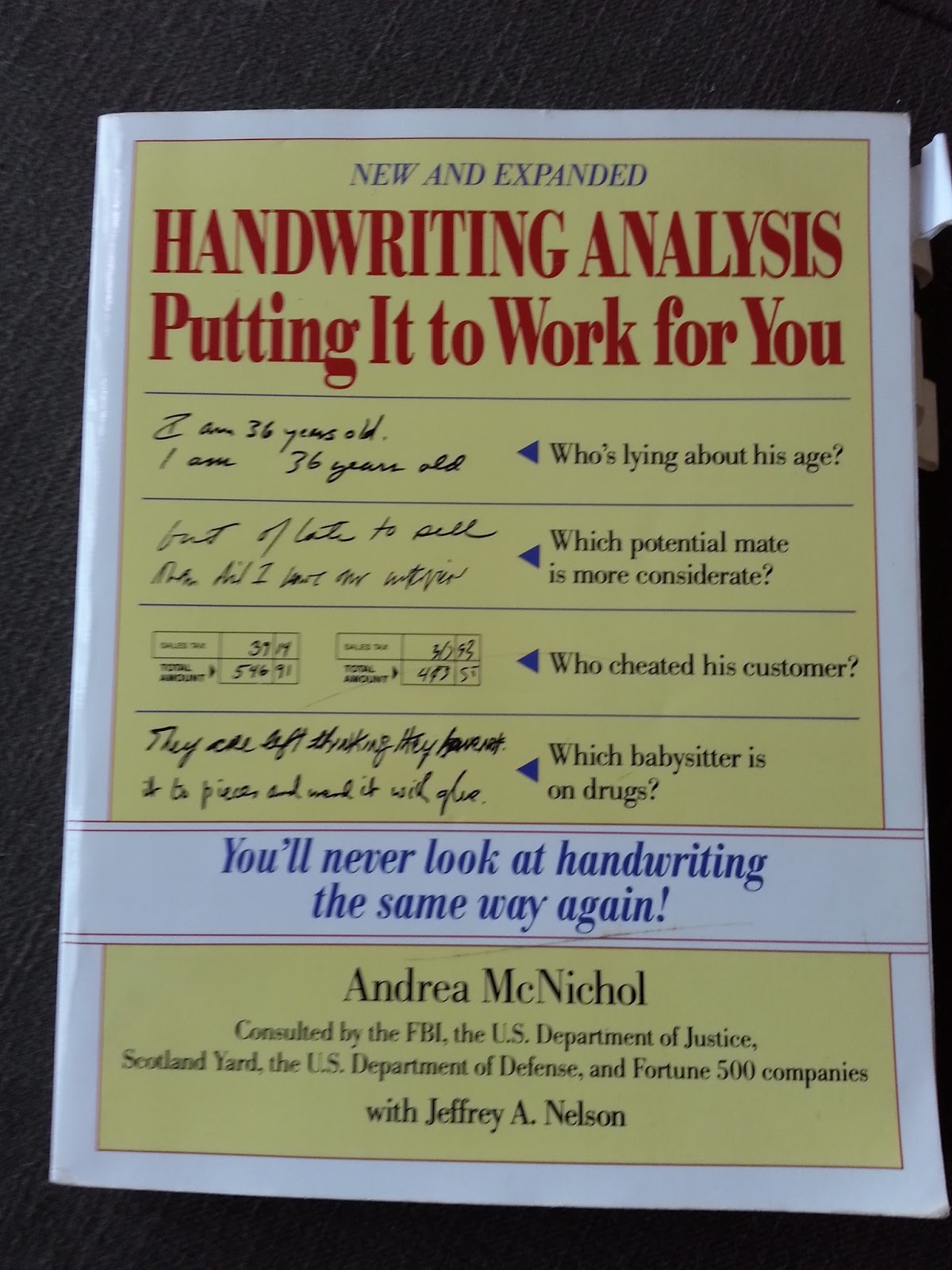
Is Handwriting Analysis a Dying Skills?

13 April 2014 - Singapore: Today, I went to the local community library and saw a handwriting analysis book by Marc Seifer, PhD. I flip a few pages and straight away I took it to the 'load machine' to record it under my name.

Recalling back, each time I share my knowledge about 'handwriting analysis' or 'graphology' - the first usual respond I got is .... "Mr. Liew ... now days people type more, do you think handwriting analysis is still relevant?"

I was introduced to handwriting analysis back in the mid 1990s - a headhunter from TOA shared her knowledge with and gave me a quick interpretation of my handwriting ... it was accurate about my personality. Later, another headhunter from HRnet One, shared with me that he use handwriting analysis to analyse the personality profile of his candidates. This really got me hooked to handwriting analysis but during the 90s, there wasn't any reading material on handwriting analysis. 

My break came when my French boss asked me to select a training that will help me in my daily HR tasks ... the rest was history ... the 2 days course on handwriting analysis cost my company RM1750 and this is in the mid 1990s. It was very expensive to invest on a young HR Officer like me. During the course ... my course-mates were from the Singapore & Malaysia police force, and the petroleum companies e.g., Petronas, LNG, SHELL, etc.

To keep it short - I just wanted to share some of the reading material available and hope the HR professional from the "Gen Y" age group  will consider picking up the skills.


Click the hyperlink:


The End

Saturday, April 5, 2014

BBC. com: Resume or CV? A Global Guide

05 April 2014, Singapore: Came across this article via LinkedIn. It is an interesting reading ... Great if you are a HR professional ... at least you will be able to explain "Resume" and "CV".

Click the hyperlink: 
BBC.com : Resume or CV! A Global Guide

Note: Do remember to click the pictures as it is linked the other section of the article. Happy reading ... knowledge is power!

Summary: In USA ... they call it resume ... keep it short by elaborate!! In Europe and Latin America ... they call it CV


-The End-

Saturday, January 25, 2014

Oxford Group: Why do Conversations Matter?

25 January 2014, Singapore: Received from my LinkedIn contact. The one page article talk about why having a conversation with people is important. It lead to trust and engagement. Click the hyperlink.


-The End-

Thursday, January 23, 2014

Talentsmart: Why Successful People Never Bring Smartphones into Meetings

23 January 2014, Singapore: New insight for people who love to carry their smart-phone into meetings. Click the hyperlink for details.


-The End-

Hay Group Whitepaper: Stop Your Best People from Walking

23 January 2014, Singapore: No harm reading the whitepaper. You might be asked to focus on talent retention after the 2013 bonus payout. Click the hyperlink.


-The End-

Wednesday, January 22, 2014

Infographic: Contingent Labor (Based on US Labor Information)

22 January 2014, Singapore: I always believe a picture paint a thousand words ... I am beginning to appreciate "infographics" way of presentation. Straight to the point! The information will provide some trends on contingent labor. I believe Singapore labor market is heading towards a 'contingent' approach ... even at senior management level position.

Click the picture to enlarge it or just click the hyperlink:


-The End-

Tuesday, January 21, 2014

Organizational Development: Creating Positive Organization

21 January 2014, Singapore: An interesting article about introducing changes to our organization culture or practices. Is the senior leadership interested to create a "positive organization"? For company productivity and enhancing the employee engagement program?

Click the hyperlink:


-The End-